

Harry William Whanslaw (1883–1965), affectionately known as “Whanny,” began his working life training for his father’s tailoring business, but his interests soon drew him toward art. After six years at the Putney School of Art, where he studied historical costume, architecture, and past cultures, he established a promising career as an illustrator, exhibiting at the Royal Academy in 1914. During the First World War he served in the Royal Army Medical Corps, a period that also rekindled his childhood fascination with toy theatre and marionettes, prompting him to explore the craft more seriously.
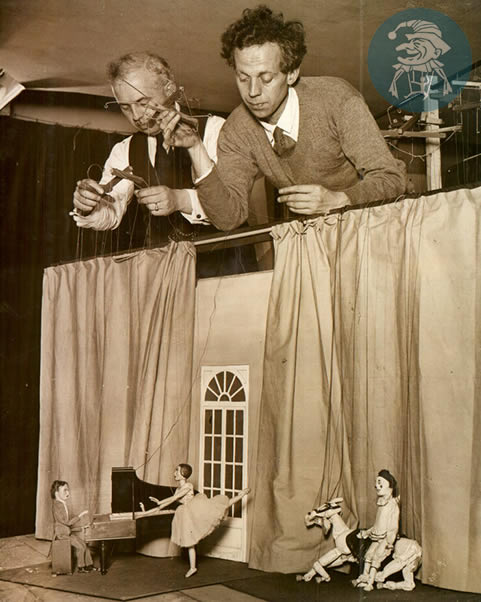
After the war, Whanslaw returned to London, where a chance encounter with a Spanish toy theatre inspired him to design his own. His illustrated articles on toy theatre for Chatterbox proved so popular that they were collected into the book Everybody’s Theatre (1923). The correspondence that followed led directly to the founding of the British Model Theatre Guild in 1925. A pivotal early meeting with Waldo Lanchester resulted in the creation of the Whanslaw–Lanchester Marionettes, later the London Marionette Theatre, which achieved several notable firsts, including producing the earliest puppets ever broadcast on television. Alongside performing, Whanslaw became one of Britain’s most influential authors on puppetry, producing a substantial body of practical, richly illustrated books. He served as President of the Guild from 1948 until his death in 1965 and is remembered with deep affection as a foundational figure in modern British puppetry.
Waldo Lanchester (1897–1978) was one of the most influential British puppeteers of the twentieth century, renowned for his craftsmanship, technical innovation and commitment to elevating marionette theatre as an art form. Born into a creative family, his sister was the actress Elsa Lanchester, he discovered puppetry as a young man and quickly developed a reputation for precision carving and expressive movement.
In 1935, Lanchester established the Lanchester Marionettes in Malvern, Worcestershire, with his wife, the ceramicist Muriel Lanchester. The company gained national prominence, performing for royalty, touring widely, and staging sophisticated works such as George Bernard Shaw’s specially written puppet play Shakes versus Shav. Their work helped define the artistic possibilities of marionette theatre in Britain and left a lasting legacy on the development of the craft.