
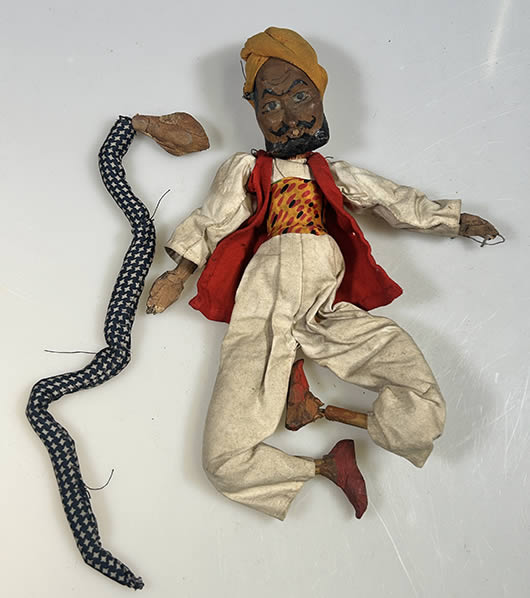
Mango Chutney, an Arabian snake‑charmer, was one of the earliest speciality acts in the repertoire of the London Marionette Theatre. His appearance reflects the company’s taste for vivid character types and tightly choreographed miniature “turns” that could be inserted into mixed programmes.
The origins of the theatre lie in a small demonstration given on 5 October 1926 at a meeting of the British Model Theatre Guild, where Harry Whanslaw and Waldo Lanchester presented a handful of their marionettes. The enthusiastic response encouraged them to form a professional partnership, and in January 1927 they began performing publicly as the Whanslaw–Lanchester Marionettes. Early engagements at private homes, parties and exhibitions quickly built their reputation.
As demand grew, the company adopted the name London Marionette Theatre and established a base in a row of outbuildings behind Ravenscourt Gardens in Stamford Brook, where Lanchester lived and constructed a stage above his workshop. The repertoire expanded steadily, and the company employed a young Jan Bussell, later celebrated—together with Ann Hogarth—as one half of the Hogarth Puppets. Performances at “The Mews” regularly attracted full invited audiences and helped revive a style of marionette theatre that had largely vanished from London.
In 1935, after eight productive years, Whanslaw and Lanchester amicably ended their partnership. Whanslaw went on to found the Studio Marionette Theatre in Chiswick, while Lanchester established the influential Lanchester Marionette Theatre in Malvern. The name London Marionette Theatre continued under the direction of Waldo’s mother, Edith Lanchester, until 1947, preserving the legacy of one of Britain’s most formative marionette companies.